


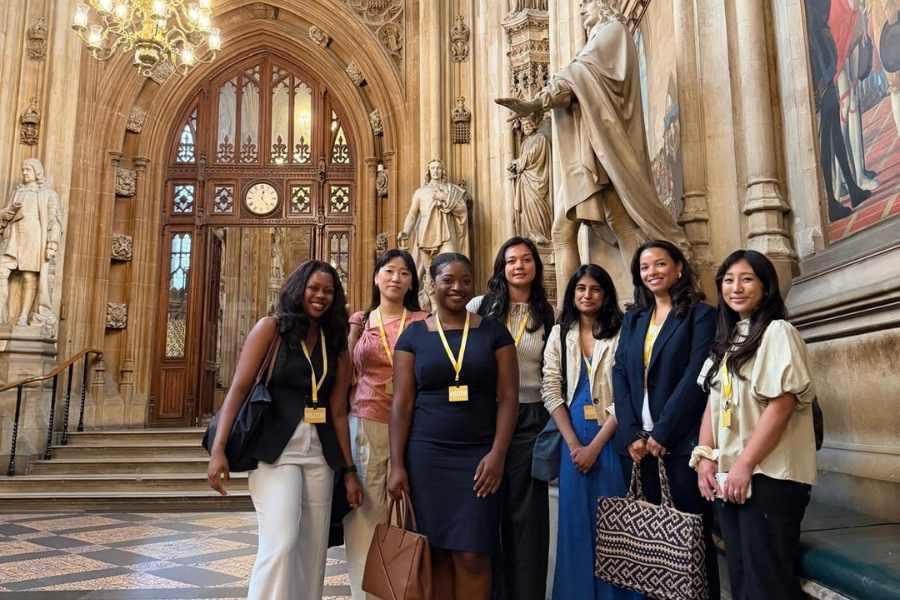
By Rianna Nayee, MPS Mentee
On 22 July, members of MPS’ inaugural mentorship scheme attended the House of Lords International Relations and Defence Committee evidence session held as part of its inquiry on Multilateralism.
It was a fantastic opportunity to see up close how Parliament helps to scrutinise and inform the UK Government’s decision-making process. MPS’ Government Relations Advisor, Leila Laing, organised the visit, along with a lunch where we could discuss what we learned at the session. For some it was their first time in Parliament, and it was a particularly interesting time to be in Westminster, only days after the new Prime Minister Andy Burnham assumed office. I was eager to hear parliamentarians' different views on the state of international politics during a time of protracted upheaval.
The UK and the state of Multilateralism
The Committee heard from Professor Stefan Dercon (Professor of Economic Policy, Blavatnik School of Government at University of Oxford) and Professor Ian Goldin (Professor of Globalisation and Development, Martin School at University of Oxford) on the state of multilateralism.
The Committee Chair, Lord Robertson of Port Ellen, opened the session by asking whether the Professors believed the multilateral system was in crisis. Professor Goldin argued that the global multilateral system is in crisis due to the approaches taken by the shareholders of these institutions, i.e. the major Governments of the world: “You certainly would not want to look to the Security Council for help if you were in Ukraine or Palestine or Sudan. That and many other parts of the system are totally unfit for 21st-century purpose.”
Notably, Professor Goldin had a pessimistic outlook on improving the system: “The whole system needs reform. I do not think that that is going to happen in my lifetime, but that does not mean that one should not be arguing for it and aligning oneself.” Perhaps there are some opportunities, though. Professor Dercon tempered this view: “I would not give up. It is difficult. The current crisis in the UN system - especially in New York, which has a lot to do with finance being massively curtailed - is an opportunity.”
The Committee reckoned with the UK’s changed role on the world stage. Professor Dercon argued that today the UK is a medium-sized economy “very much exposed to global forces”. He stressed that a transactional focus on national interest was counter-productive. Instead it is important to build coalitions, work in partnerships, and be selective: identify the UK’s strengths and focus on them.
Afterwards, we toured Parliament (the public bits!) and discussed the Evidence Session over coffee in the parliamentary cafe. It struck me, and many others, that too often it is simply accepted that change is not possible, especially when addressing large institutions with long histories. Progress is framed as a pipe dream, rather than something we can actively choose to foster and champion. As a young person hoping to help build a more just and sustainable world, I desperately hope that we can change that outlook. Change is possible in our lifetime; it will require bringing in wider perspectives. I left the session thinking how important MPS’ work is, to that end.
What MPS means to me
MPS seeks to address a clear gap in peace and security policymaking in the UK: the exclusion and marginalisation of minority communities in policy debates that disproportionately affect them. Ahead of the session, MPS submitted evidence to the inquiry, bringing together insight from expert advisers, and inviting their mentees to share perspectives. This is just one way MPS puts its goals into action, and why I am glad to be an MPS mentee.


