


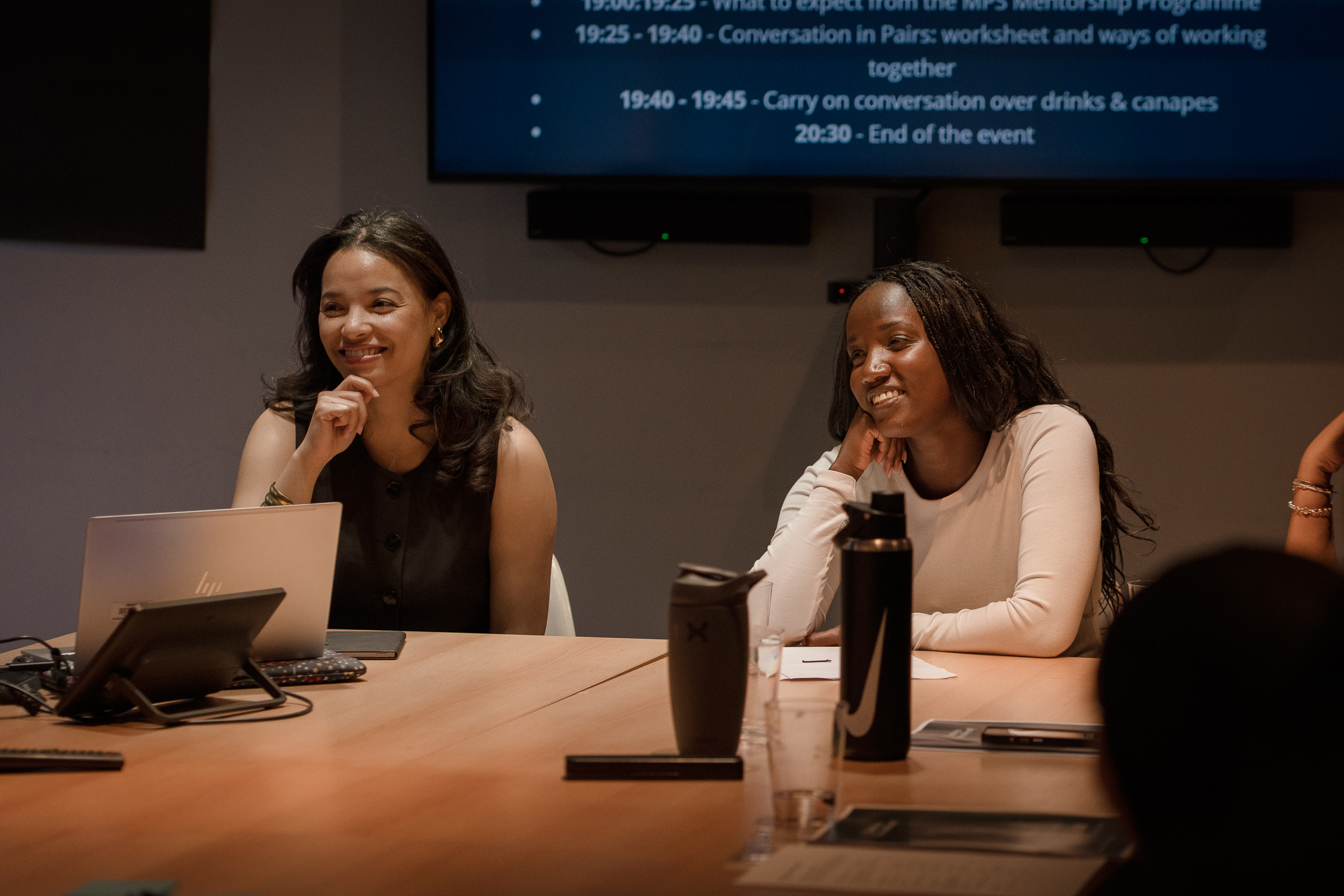
On 27 April in London, we launched our first mentorship programme marking a significant step in its efforts to advance inclusion across the peace and security sector. The six-month initiative opened with a keynote address from Carine Kanimba, General Secretary of the World Liberty Congress, who set the tone for the programme with a call for greater global solidarity and protection of peace & security professionals and advocates.
Despite growing recognition of the importance of diversity, the voices and expertise of minorities - including immigrants, people of colour, refugees and asylum seekers, LGBTQIA+ individuals, people with disabilities, women, and gender minorities - remain underrepresented in peace and security decision-making. Research consistently shows that exclusion from these processes contributes to fragile and unsustainable peace agreements, while reinforcing the root causes of conflict. The result is often security frameworks that are narrow in scope and less effective in the long term.
MPS’s mentorship programme responds directly to these challenges by fostering solidarity among minorities and allies in peace and security, while promoting equity, representation, and intersectional approaches. The 2026 cohort brings together seven young professionals and seven experts from across sectors, and as a pilot, will both support participants’ development and help shape the future of MPS’s mentorship model.
Carine Kanimba, a prominent human rights advocate and daughter of Paul Rusesabagina, has been widely recognised for her work defending human rights activists, exposing digital surveillance abuses, and advancing democratic values worldwide. Her participation underscored the programme’s broader commitment to amplifying underrepresented voices and strengthening inclusive leadership in global peace and security efforts.
You can find a transcript of Carine’s full speech from the opening event below.
Speech from Carine Kanimba at BFI Stephen Street, Monday 27 April 2026:
Thank you so much to MPS for inviting me, and congratulations on the launch of this mentorship programme. It is really meaningful to be in a room with mentors and mentees who are not only thinking about careers, but also about how we make the peace and security field more honest, more representative, and more human.
When I read the piece by Aditi and Melina, what struck me most was this idea of arriving, surviving, and thriving.
Because for many of us, entering these spaces is not just a career choice. It is personal.
For me, peace and security has never been abstract. It has never been something that only happens in policy papers, diplomatic statements, or conference rooms. It has shaped my family, my life, and my sense of responsibility.
My father, Paul Rusesabagina, was kidnapped, taken across borders, tortured, and held as a political prisoner. For almost three years, my family had to fight for his freedom. We had to learn very quickly how international advocacy works: how to speak to governments, parliaments, human rights organisations, lawyers, journalists, and diplomats. We had to learn how to turn personal pain into public action.
That experience changed my life. It taught me that peace and security decisions are never just technical. They determine who is protected, who is ignored, whose suffering is believed, and whose suffering is treated as politically inconvenient.
It also taught me that the people closest to injustice often understand these systems most clearly. But too often, they are the last people invited into the room.
That is why spaces like MPS matter.
At the World Liberty Congress, where I serve as General Secretary, I work with democracy leaders, former political prisoners, activists, and human rights defenders from all over the world. Many of them come from countries where the cost of speaking out is prison, exile, surveillance, torture, or worse.
What I see every day is that lived experience is not a weakness. It is expertise.
People who have lived through repression understand how authoritarian systems work in ways that no textbook can fully explain. People who have been displaced understand the failures of international protection systems. People who have experienced racism, exclusion, or marginalisation understand what it means when institutions say they are neutral, but are not built for everyone.
And yet, in peace and security spaces, lived experience is still often treated as emotional, anecdotal, or secondary. We are told to be objective, to be professional, to be less personal.
But the personal is often where the truth is.
Of course, lived experience alone is not enough. We also need skills, discipline, strategy, legal knowledge, political analysis, and strong institutions. But when those tools are disconnected from the people most affected, policy becomes incomplete. It becomes something done about people, not with them.
For minorities in this field, one of the biggest challenges is that we are often asked to prove ourselves twice. We have to prove our expertise, and then we have to prove that our background does not make us biased. Meanwhile, others are allowed to speak from their worldview and call it neutrality.
That double standard is exhausting.
Many of us know what it feels like to walk into rooms where no one looks like us, where our names are mispronounced, where our contributions are overlooked until someone else repeats them, where we are asked to represent an entire region, race, religion, or community.
We know what it feels like to be grateful for being included, while also knowing that inclusion is not the same as power.
And that is why mentorship is so important.
Mentorship is not only about helping someone get a job or polish a CV. At its best, mentorship is about helping people stay in the room without losing themselves. It is about giving people the confidence to know that they belong, and the tools to navigate systems that were not necessarily designed with them in mind.
A good mentor can help you understand the unwritten rules. But an even better mentor helps you question which rules need to change.
For the mentees here today, I would say this: do not underestimate the value of your perspective. The things that made you feel different may also be the things that allow you to see what others miss.
But also, do not feel that you have to carry everything alone. You do not have to be the spokesperson for every injustice. You do not have to turn every painful experience into a lesson for others. You are allowed to grow, to make mistakes, to rest, and to choose your battles.
For the mentors, I would say: your role is not only to open doors, but to help change what happens after someone walks through them. It is not enough to bring minorities into institutions if those institutions still expect them to shrink, assimilate, or burn out.
We need mentors who sponsor, not just advise. Who name people’s talent in rooms they are not in. Who challenge tokenism. Who understand that diversity without actual influence is decoration.
In my own journey, I have learned that change often happens because someone decides to make space. Someone introduces you. Someone trusts you with responsibility. Someone says your name when opportunities are being discussed. Someone tells you, “You can do this,” at a moment when you are not sure you can.
That is what this programme can offer.
And at this moment, the peace and security field urgently needs new voices. The world is facing democratic backsliding, wars, mass displacement, political imprisonment, digital surveillance, transnational repression, and growing distrust in institutions. We cannot respond to these challenges with the same narrow circles of expertise and the same blind spots.
We need people who understand complexity because they have lived it. We need people who can connect policy to people’s actual lives. We need people who know that security is not only about borders and states, but about dignity, freedom, belonging, and the right to live without fear.
So my message today is simple: your presence in this field matters. Not because minority voices are symbolic, but because they are necessary.
The goal is not simply to be included in existing spaces. The goal is to help reshape them.
Thank you, and congratulations again to MPS, the mentors, and the mentees. I am really looking forward to the conversation.
About Carine Kanimba:
Carine Kanimba is the General Secretary of the World Liberty Congress. She is a human rights advocate dedicated to advancing freedom, justice, and accountability around the world. Her work focuses on protecting human rights defenders, exposing digital surveillance abuses, and strengthening global solidarity for democracy.
In 2021, Amnesty International and Citizen Lab confirmed through forensic analysis that Carine’s phone had been infected with Pegasus spyware, likely deployed by the Rwandan government. She later testified before the U.S. Congress House Intelligence Committee and the European Parliament, sharing her experience and calling for global accountability and stronger regulation of the spyware industry.
Carine has also spoken out against sportswashing — the use of global sporting events and sponsorships by authoritarian regimes to sanitize their image and divert attention from human rights abuses. She has urged democratic governments, institutions, and corporations to uphold integrity, transparency, and human rights in international engagement.
A survivor of Rwanda’s 1994 genocide, Carine’s dedication to justice is deeply influenced by her family’s experience. Her father, Paul Rusesabagina, saved over 1,200 lives during the genocide — an act later portrayed in Hotel Rwanda. When he was forcibly taken to Rwanda in 2020 and unjustly imprisoned for his political views, Carine led the #FreeRusesabagina campaign, mobilizing a global coalition of institutions, governments, and civil society organizations that ultimately secured his release in 2023.
Her leadership and advocacy have been recognized internationally, earning her the Heroes of Democracy Award from the Renew Democracy Initiative (2023), the Global Magnitsky Justice Award for Young Human Rights Activists (2023), and the Inspiring Woman of the Year Award from the Berkeley Global Society (2024).
Carine’s work and insights have been featured on CNN, BBC, Al Jazeera, NPR, Channel 4, France 24, TV5 Monde, The Guardian, Le Soir, The Washington Post, The New York Times, Financial Times, Paris Match, and The Sunday Times, among others.
Through her advocacy, Carine continues to champion the rights of political prisoners, confront transnational repression, and build alliances that strengthen the global movement for democracy and human freedom.
.png)


